Dema Rose Patterson: Rosebud Country Rancher and Teacher
The South Dakota Oral History Center (SDOHC) contains thousands of recordings and transcripts of individuals who settled in South Dakota in the late part of the nineteenth and early part of the twentieth century. This blog concerns a transcript of an interview with Mrs. Raymond Patterson (Dema Rose Patterson) by Ralph Searles, Dan Bassill, and Tom Dunnavin in Gregory, South Dakota on January 10, 1968. As part of my work for the SDOHC, I am re-formatting text after converting a PDF scan of the original transcript in a word document, tasked with staying as true as possible to the original transcript.
Selected excerpts of Ms. Patterson’s words from the twenty-two-page transcribed interview are presented in quotations. As a convention in transcripts of oral history interviews, I made no grammatical or spelling corrections. A space designated by a line (_____) indicates that the transcriber was unsure of what was said.
Ralph Searles, an interviewer, first read a narrative that Ms. Patterson and her sister Lois Zimmer wrote about their mother, Dema M. Rose, and father, Charles M. Rose, both early pioneers in Dallas, South Dakota. The Roses moved from Eskridge, Kansas to Gregory County in 1904. They homesteaded near Herrick. Both were teachers. According to the narrative and his obituary, Charles Rose was also mayor of Dallas, a newspaper man, rancher, real estate dealer, and writer (Winner Advocate, Winner, South Dakota, March 27, 1952). He called himself the “Rose of Rosebud”.
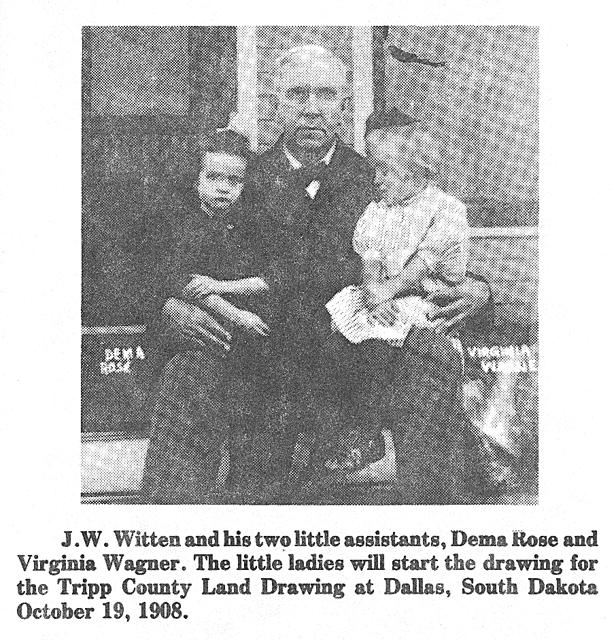
During the interview, Ms. Patterson mentioned that in 1908, when she was four years old, she and another child were chosen to draw numbers for the Rosebud Indian Land Lottery for claims in newly formed Tripp County. Aside from Dallas, other cities, including Gregory and Chamberlain, participated in the lottery. Ms. Patterson recalled, “There were 17 barrels and each of them held over a thousand letters.” She continues, “we had picked up to 500 numbers, and somebody decided we were getting kind of tired.” Subsequently, some boys continued drawing numbers. A picture of the two girls, Dema Rose, the mayor’s daughter, and Virginia Wagner, niece of a town founder, is shown below. (From: Dallas, South Dakota: The End of the Line. Dallas Historical Society, 1977, page 144.)
Growing up on the ranch, Ms. Patterson mentioned that her duties included milking cows and herding cattle. She started doing these chores at 12 years of age. Ms. Patterson recalled, “Oh yes, I milked a slew of cows every morning and night and would herd cattle all day long.” While herding cattle, she would encounter prairie chickens. As she recalls, “And I made friends with prairie chickens when I herded cattle. I used to share my lunch with them. And I would take out cans of water out of my supplies. So, then they didn't have to travel so far to get water for their broods.”
Dema Rose Patterson remarked that she also broke many horses to ride as part of her ranching tasks. She explained, “Well, I always did what I called the humane way. I would teach them to get used to a saddle and bridle by wearing them in the corral and I'd tie things on their saddle to flip flop and they'd get used to this. Before I ever got on them.” The only problem that she described as a result of this process was, “I didn't weigh a hundred pounds in those days, and I had several horses that I broke quite successfully for me and yet when they got out and they 'got a man to ride them, why they were wild because they couldn't take that added weight.”
A large part of the second part of the interview deals with Ms. Patterson’s career as a teacher in the 1920s. Her first teaching job was in a probation school in Mission, South Dakota. She described experiences with two students.
One student had difficulties with mathematics and later brought a loaded pistol to school. To deal with the first situation Ms. Patterson stated, “He hadn't gotten arithmetic and he wasn't going to get it.” Later the conversation continued, “He wanted to have a new pair or chaps made and he'd furnish the sheep skin, how much it would cost him for sheepskin chaps. Well, then I figured out the percentages for him and then about the second time with a proposition and I said, "You know, if you'd look on page so and so in your arithmetic book, it shows you Just how to work that problem and you could figure it out for yourself.” And I said, “I suggest you get the book and you can check it out for an hour. You can figure it out for yourself."
Although the lad learned arithmetic from several practical examples, one day he brought a loaded pistol to school. Ms. Patterson recalled, “on a very hot Saturday morning and he had a gun belt and a .38 gun in this gun belt and I told him, ’Now, listen Adolph, we can’t have any guns in school.” And I said, "You put the gun up on my desk’ and I says ‘at recess time we'll go out and shoot out what bullets you have to see who’s the best shot, you or I. ’
Ms. Patterson continued, “I says, ‘We'll see who can shoot those cans off the post out there.’ “Well okay”, he says, “If you think you can outshoot me, well try it.” I says, “Well if the Lord is with me, I think I can outshoot you maybe.” And I says, “We can try, try at least.” We did and luckily, I made a pretty fair show and got more cans off the posts than he did and so he went home with an empty gun anyway.” After this interaction, Ms. Patterson stated that Adolph never brought a gun to school again.
A final story concerned a white seven-year-old student, George, who never had had a bath and was barefoot. Ms. Patterson, with the help of townspeople, was able to bathe the boy, cut his hair, take lice out of his hair, and get him new clothing. Subsequently, she stated, “ Every week he got a Saturday night bath and a change of clothes.”
However, the boy’s father was furious about what was done to his son. Ms. Patterson mentioned regarding the father, “He come to town to kill me. And them men had suggested to me that I stay scarce. Because if he takes a shot at you first_______he'll probably take a shot at you and you won't have a chance. They said you pay no attention to him and we'll watch for them and we'll try not to let him near the school or any place where you’re going.” Luckily the two never met.
This interview presents first-hand accounts of a young woman growing up during a time of changing relationships between settlers and Indians in Rosebud County, populating and developing land in newly formed Tripp and Gregory counties, working on a ranch, being influenced by remarkable parents, and teaching in rural schools. It adds to the rich history of life in South Dakota during the first quarter of the twentieth century.


Comments