Homesteading in the Badlands and Interior, South Dakota
This blog is based on a transcript of an interview by University of South Dakota Professor Stephen Ward and John Stockert (Naturalist and Executive Secretary of the Badlands Natural History Association) on August 5, 1970, as part of the South Dakota Oral History Project (SDOHP #0068). Ward and Stockert interviewed John and Celia Everett who were early homesteaders in Jackson County, South Dakota. The couple married in Spencer, Iowa in 1910 and then moved to the Badlands shortly afterwards. They first homesteaded near Cedar Pass in the Badlands and later homesteaded near Interior, South Dakota until 1942.
Please note that in this blog I did not alter spelling or grammar from the original transcript as identified by quotation marks. The lines (____) indicate that the transcriber was not sure of what the interviewee said.
The Everetts were ranchers who had cattle, turkeys, milk cows, and hogs. They cultivated a large garden and raised alfalfa for cattle feed. When they first homesteaded, cattle were branded. Because at that time the land had no fences, cattle roamed freely. Cattle also grazed on Pine Ridge Reservation land close to their homestead. As more settlers moved to the area, landowners fenced their property.
John and Celia also mentioned wild animals they encountered on their homesteads including rattlesnakes, skunks, prairie dogs, wolves, and coyotes. Celia described a close encounter with a rattlesnake in her home as follows.
“I tell you one time, John was (sleeping?) this was on Sunday morning and he was (sleeping?) and we had a little hole dug down under that cabin that we used as________butter, cream and milk down there. And I now___________down in there to get some butter. And I_______ made a noise and I looked at it and there____________thing was crawling right around my butter dish there, and I didn't want no butter.” (laughter)
The couple were Catholics. They had no access to a Catholic Church in Interior, South Dakota and had mass once a month in their home. After going occasionally to the Presbyterian church in Interior, they became members of that church.
Celia Everett also discussed the emergence of the Ku Klux Klan in the Black Hills and Badlands in the 1920s. Prior to attending a KKK meeting Celia Everett mentioned “"Why can't you ask me?" and she said, "You wouldn't want to go to that, would you?" "Yes,", I said, "I, I'd like to go and hear what they got to say. I'd like to see what they’re doing."” She goes on to relate that some residents were against the KKK, according to Celia Everett, a friend stated, ““No," he says, "I'm not gonna join it. It looks like it's (there) just to be against the Catholics," he says, "Some of those Catholics are my very best friends," and he says, "I'm not gonna join it.””
John Stockert asked why the KKK didn’t last in Interior. Celia Everett remarked, “ Oh, I don't think it lasted long, you know what happened then, you know, all those men that signed up and they signed up all right, but they didn't pay their dues. You know, the old fella come there and they wanted their dues.”
In another portion of the interview, Celia mentioned that geologists, archeologists, and paleontologists visited the Badlands which was rich in fossils. The following interchange between John Stockert and Celia Everett illustrated what transpired. “We had geologists there in, let's see, now (Eddie?) was about 8 years old and they dug up, you know, back in the_____________they'd dig out and bring out all different kinds of bones. And they'd, they'd tell us what, what some of them animals,_______________but I can't remember what kind they thought they were.” Celia Everett identified the geologists as Drs. Brunt and Ward. The Everetts also mentioned finding Indian artifacts.
When their children were old enough to go to school, the family moved into a house in Interior, SD. John and Celia also discussed the effects of the Great Depression, grasshopper plagues, lack of rain, and the Dust Bowl on their livelihood including loss of cattle and horses when feed was unavailable. They survived by selling turkeys. Finally, the couple mentioned the development of the Badlands National Monument and John’s role in constructing tunnels there. Interior became the gateway to the Badlands Monument.
This interview presents a window into homesteading near the Badlands. According to their obituaries, in the 1950s the Everetts moved to Rapid City where they lived for the rest of their lives.
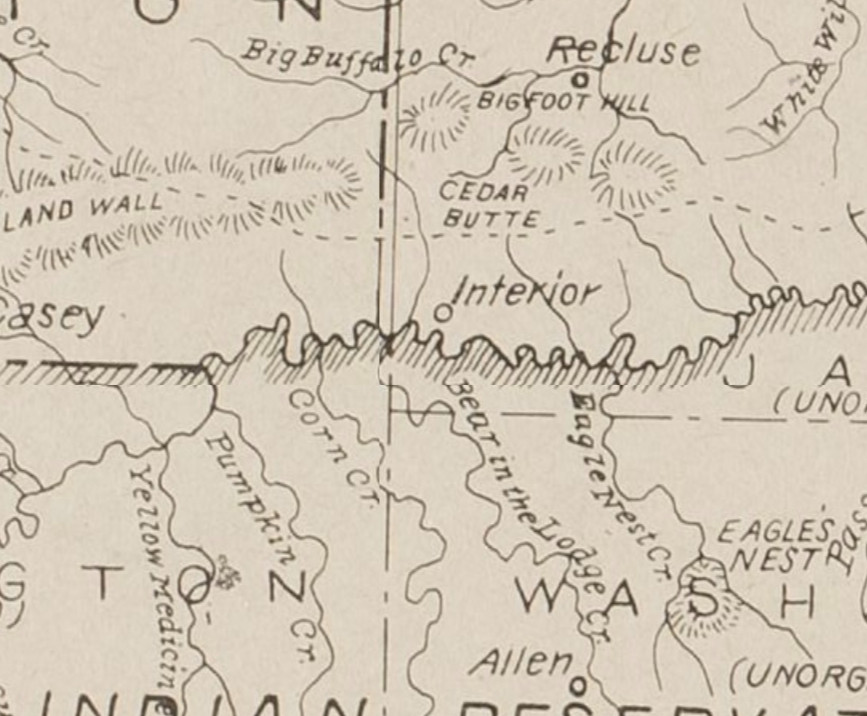
*Interior, South Dakota in 1904. Note that the city was part of Pennington County at that time and was located just north of the Pine Ridge Indian Reservation.
References:
South Dakota Oral History Project. Interview: SDOHP #0068.
Charles Rambow. The Ku Klux Klan in the 1920s: A Concentration on the Black Hills. South Dakota History. Vol. 4, Issue 1, 1973.
Mattison, Ray H. and Robert A. Grom. History of Badlands National Monument, and the White River (Big) Badlands of South Dakota. [1st ed.], Badlands Natural History Association, 1970.
Hall, Philip S. Reflections of the Badlands. University of South Dakota Press, 1993.
* Peterson, E. Frank. Historical Atlas of South Dakota: Containing State and County Maps, Geologic Maps, Statistical Charts, Geography, Geology, History, Descriptive Notes, Tables, Etc. University of South Dakota, 1904.


Comments