Search


Search this site
376 results found with an empty search
- Secret Grove would be a great place to celebrate this beautiful fall weather. Do you think it is still there? #mapmonday
It was south and west of Yankton, Dakota Territory. This 1872 map can be viewed in the Archives and Special Collections. Map of Military Department of the Platte, Nebraska. Washington, D.C.: Engineer Dept., U.S. Army (Washington D.C.: N. Peters, Photo-lithographer), 1872. CHILSON COLLECTION MAP 4190 W728 1872
- October is American Archives Month.
While doing research in an archival collection, have you ever come across intriguing, but completely off-topic items that have nothing to do with your research? For example, while working with the Edward Perry Churchill collection I found a research paper he wrote in 1916 on “The Learning of a Maze by Goldfish.” What do you think? Did the goldfish figure out the maze? This research paper can be found in the Printed Material series, Box 2, Edward Perry Churchill papers. Happy Archives Month
- Happy #ArchivesMonth and Happy Halloween
While doing research in an archival collection, have you ever come across intriguing, but completely off-topic items that have nothing to do with your research? Working with the George Prescott Scott papers in the Archives and Special Collections, I found a presentation he gave in 1982 on “Split Brains and Spooky Vibes.” Title aside, the presentation is a surprisingly serious essay on biophysical chemistry. While in the archival box, check out the folder on the Spooky Vibes Emblem, which is based on shapes found in nature. This presentation can be found in the Presentations/Plays/Poems series, box 6, folder 25, George Prescott Scott papers.
- Former SD Governor Frank Farrar passed away yesterday.
The following summary is from the guide to his papers at the Archives and Special Collections: Frank L. Farrar was born April 2, 1929, in Britton, South Dakota. Farrar was the only Governor of South Dakota who was also elected governor at South Dakota Boys State. He attended and graduated from the University of South Dakota with a business degree and a law degree. He served in the Korean War. In 1953, he married Patricia Henley and had five children. After leaving the army, Farrar opened a law practice in Britton, served as Marshall County Judge and State’s Attorney for Marshall County. He was also elected president of the South Dakota State’s Attorneys Association. Then, Farrar was elected as the youngest South Dakota Attorney General for three two-year terms in 1962. In 1968, Farrar was elected governor. One of his major accomplishments was signing the Narcotics Drug Act to fight against drug users and dealers. In 1970 he was defeated for reelection and returned to his law practice. The Frank L. Farrar papers consist primarily of materials from his time as South Dakota governor. Collection size 3.5 linear ft.
- Mr. On Spe Sni
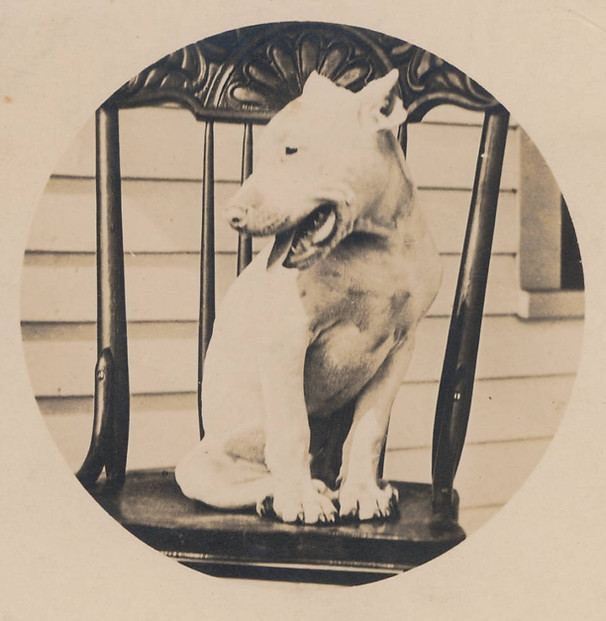
This vintage photograph postcard is in the Works Progress Administration Records in the Archives and Special Collections. It was copyrighted in 1912 by L. E. Stair of Mitchell, SD. The WPA Records also contain a short story about this photograph as told by Mr. L. E. Stair.
- The Missouri River Commission made very detailed and accurate maps of the Missouri River in 1892-1895. #MapMonday
Darrow, A. N., et al. Map of the Missouri River : from Its Mouth to Three Forks, Montana. Missouri River Commission, 1892-1895. Archives and Special Collections doesn’t have all the maps in this set, but we do have the indexes and maps for South Dakota under call number RICHARDSON COLLECTION 1472 M5 1895 U545. This map shows Vermillion, South Dakota and area after the flood of 1881 moved the Missouri River away from the town.
- There are student and alumni publications in the Archives and Special Collections.
We wish we had more. Please, please donate your USD student group’s publications to the archives. They will tell future researchers so much about USD. Below are listed the student publications we currently have in the Archives and Special Collections. Student Publications: The Blast, magazine, 1954 to 1968 Blue Print, magazine, 1917 to 1927 The Coyote, annual yearbook, 1903 to 1886 The Coyote, student weekly newspaper, 1893 to 1894 The Cynic, student newspaper, 1889 to 1890 Hm-m, 1951 to 1952 Houtz Review, 1960s Inter noose or Inter Nos, magazine, 1961 to 1969 Julian-Brookman Forum, 1973 Magazine, It’s a Real Blast, magazine, 1963, Is this a part of The Blast series? Maverick, 1964 Rebel, 1966 to 1968 Strollers, magazine, 1971 to 1989 Red Ink, 1948 Research and Scholarship Club Bulletin, 1940 Satyr, 1973 to 1974 The Scribbler, 1926 to 1938 South Dakota Student News, date unknown Student Activities Center Newsletter, 1987 to 1992 SUSD Journalism Reporter, 1958 U Lo-Down, newspaper, 1930, 1936 Up Yours, magazine, 1974 Veritas, newspaper, 1889 Vigilante, newspaper, 1980 Volante, newspaper, 1887 to present Wet Hen, magazine, 1926 to 1947 Alumni Publications: South Dakota Alumni Quarterly, magazine, 1905 to 1924 South Dakota Alumnus, magazine, 1924 to 1941 South Dakotan, magazine, 1970 to the present South Dakotan Arts and Sciences, magazine, 2019 to 2020 South Dakotan Business, magazine, 2009 to 2019 South Dakotan Health, magazine, 2013 to 2020 South Dakotan Lawyer, magazine, 2010 to 2020 South Dakotan M.D., magazine, 2009 to 2020 University of South Dakota Alumni Bulletin, magazine, 1942 to 1966
- The University of South Dakota Foundation was founded 100 years ago this month.
Information from “U.S.D. Endowment Association.” The Alumni Quarterly 18 no. 1 (April 1922); 36-37. This publication can be found in the Archives and Special Collections.
- Have you tried #bookspinepoetry?
April is National Poetry Month and March 21st is International Poetry Day. Browse the shelves in the library and have fun putting titles together to form a poem that pleases you.
- Does Clay County SD have ghost towns?
If ghost towns do not need to have standing structures, then Clay County has at least one – Lodi. Bloomingdale may turn out to be another one, but further research is needed to determine if Bloomingdale was a town. Both are now private land and used for farming. Plat of Lodi from Peterson’s atlas can be viewed in the Archives and Special Collections or the Digital Library of South Dakota. The atlas has a map of Lodi plus maps of other towns or villages in Clay County. The county has a few more towns or villages that no longer exist, but they were moved rather than abandoned. Lincoln relocated and became Meckling. Please contact us if you know of other abandoned towns in Clay County, SD.


