Search

Search this site
376 results found with an empty search
- We love our Mahoney Music Collection. #ArchivesBookLove
This comprehensive music-related collection is mainly books, largely centered around stringed instruments, was created by John Mahoney, and is housed in the Archives and Special Collection at the University of South Dakota in Vermillion, SD. Library of Congress sponsors #ArchivesHashtagParty once a month. November’s topic is #ArchivesBookLove. D’Alembert Diderot: Encyclopedie Raisonne Metiers, 1767
- Louella Cable was an aquatic biologist, the first female scientist hired by the U.S. Bureau of Fisheries, a prolific researcher, a great scientific illustrator, and an USD Alumna.
Drawing by Cable from Bulletin of the Bureau of Fisheries Volume XLVIII. Dr. Cable received B.A. (1926) and M.A. (1927) degrees from the University of South Dakota. She worked for the U.S. Bureau of Fisheries, later called the U.S. Fish and Wildlife Service, from 1927 to 1970. Louella Cable, photograph from the Coyote yearbook.
- Happy Halloween. Witches like to dance.
These dancing witches and other supernatural beings are from The Celebrated Witches’ Dance, composed by Paganini, and transcribed for the piano forte by Wm. Vincent Wallace, 1852. Lithograph created by Sarony & Major, New York. This music score is located in the Mahoney Music Collection at the Archives and Special Collections, University of South Dakota. #Halloween, #DanceTillYouDrop
- Schoolwork examples from 1893
In the Archives and Special Collections, we have examples of schoolwork that were part of the South Dakota education exhibit at the World’s Columbian Exposition at Chicago in 1893. USD president, Joseph Mauck, was the head South Dakota education exhibit for the fair (Cummins, The University of South Dakota 1862-1966, p. 51).
- Is this an example of changing attitudes?
The Archives and Special Collections has a 1970s poster promoting the Library with the caption “Looking for a date? Visit the I. D. Weeks Library.” What do you think? Can 1970s attitudes towards dating and women in universities be inferred from this poster? If so, are current attitudes the same or different?
- Visit the Corn Palace in Mitchell SD.
Undated postcard from: This year, make a trip to Mitchell to see the Corn Palace and/or visit our Archives and Special Collections to read about the once common Corn Palaces: 1976. Schutt, Robert. The Corn Palace Story: with a Description of Early South Dakota and Mitchell, and a Map Indicating South Dakota Indian Reservations. Dakota News. CHILSON COLLECTION. F659.M5 S39x. 1981. World’s Only Corn Palace. Goin Co. CHILSON COLLECTION. F659.M57 W67 1981. 2005. Nygard, Travis E. Oscar Howe and the Metaphorical Monarchy on Maize: Indigenism and Power in the Mitchell Corn Palace Panels, 1948-1971. Thesis (M.A., Art History). University of Pittsburgh. SPECIAL BOOKS. NA6750.A2 U62 2005. 2010. Nygard, Travis E., and Pamela H. Simpson. “Indians at the Corn Palaces : Race and Reception at Two Midwestern Festival Buildings.” Buildings & Landscapes. SPECIAL BOOKS. NA6750.A2 U63 2010. 2012. Simpson, Pamela H. (Pamela Hemenway). Corn Palaces and Butter Queens: a History of Crop Art and Dairy Sculpture. University of Minnesota Press. SPECIAL BOOKS. NA6750.A2 U6 2012. Check out this online story about Oscar Howe, the painter, and the Corn Palace: 2016. Zimny, Michael. Gallery Documents Oscar Howe’s Long Legacy at the Corn Palace. South Dakota Public Broadcasting. https://www.sdpb.org/blogs/arts-and-culture/gallery-documents-oscar-howes-long-legacy-at-the-corn-palace/ (accessed 07/29/2022).
- What former USD Faculty member was instrumental in blocking a birth-defect-causing drug from use in the United States?
Dr. Frances Kelsey. In 1960, while at the Food and Drug Administration, she refused to approve release of thalidomide in the United States due to inadequate testing. For a portrait of Dr. Kelsey at the University of South Dakota, see the Digital Library of South Dakota.
- There are no seas in the middle of the North America continent, so this is how we play on the water in South Dakota. #ArchivesUnderTheSea
Caption on photograph is “Ben shooting the V.R. [Vermillion River] rapids. This image is from the University of South Dakota Photograph Collection and Digital Library of South Dakota. Identifier P05878.
- Farber Hall
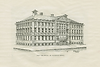
View of what is now Farber Hall in Old Main. Photograph from 1895-1896 University of South Dakota Catalog.
- Sources in the Archives and Special Collections for genealogists
Did your grandparents or great-grandparents attend the University of South Dakota? The Archives and Special Collections has the following sources to help you find out. Sources listing graduates and those who attended but did not graduate: University Catalogs, 1883-1884 school year to the current school year. Early catalogs often list enrollees. Coyote Yearbooks, 1903 through 1986. Student, Faculty, and Staff Directory (Phone books), 1919-1920 school year through 2003-2004 school year. Volante Student Newspapers, 1897 to the current date. There is an index for 1985 through 1997 Volantes. Sources listing graduates (These sources do not include those who did not graduate.): Alumni Directories. Some directories list alumni living at the time of the directory is published. Published in 1937, 1949, 1970, 1976, 1982, 1994, 2000, and 2015. Alumni Newsletters, 1905 to the current date. Title changes from the Alumni Newsletters to the Alumni Quarterly to the South Dakotan. There is an index for 1905 through 1930. Commencement Announcements, 1899 through current year. These programs often list all those who are graduating. Contact us if you want to stop by and use these sources.


