Finding Rabbit: What One Freedman’s Story Reveals About Scholarly Editing
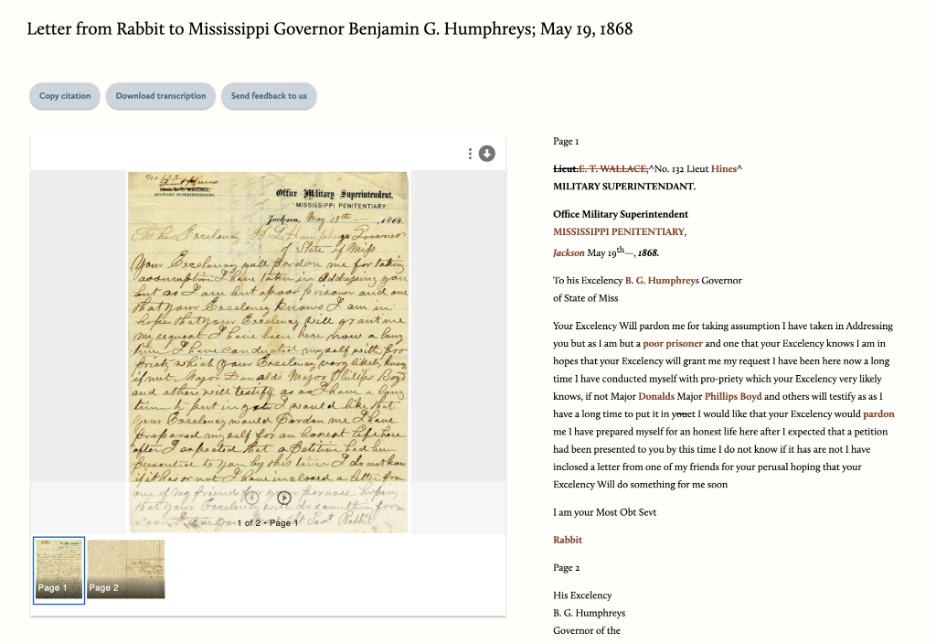
Archives and special collections have long connected users with the raw materials of our history. Researchers visiting our reading rooms encounter the past one page, photograph, and reel at a time. With collections so important to our cultural heritage, history, and future, we’ve been asking: How can university libraries expand access to these materials, help users understand them, and prepare the next generation of scholars and professionals? When the University of South Dakota Libraries hired me, part of that vision was to deepen the library’s commitment to archival access while also creating meaningful, hands-on professional development opportunities for humanities students. One powerful way archives and libraries are doing both is through digital scholarly editing. But what exactly are scholarly editions, and how do they differ from collections in digital libraries? What Is a Digital Scholarly Edition? A digital scholarly edition is more than a digital archive or scanned collection. Like digital libraries, scholarly editions provide users with access to large amounts of digitized archival materials. What distinguishes them is editorial interpretation. Researching the historical context, editors transcribe documents, identify and explain references, and create tools that help users discover and understand relationships across the collection. Through this work, scholarly editions transform historical documents from isolated records into a connected, searchable, and contextualized collection. The Civil War & Reconstruction Governors of Mississippi (CWRGM) scholarly edition — a partnership between Susannah J. Ural at Mississippi State University and I — offers an excellent example of how this works in practice. CWRGM publishes annotated, searchable editions of correspondence sent to Mississippi’s governors during one of the most transformative periods in American history. At CWRGM, users can engage with the archive in multiple ways. They can keyword-search transcriptions and metadata to quickly sift through thousands of records. At the same time, they can browse documents using the archivist’s folder arrangement, which recreates aspects of the traditional reading room experience. Blog posts and podcasts introduce users to collection highlights and editorial discoveries, while the educator resources support meaningful use of archival materials in K-12, undergraduate, and graduate classrooms. The project’s open-access structured data supports digital humanities research by making relationships across people, events, and ideas visible at scale. While these features help users explore and engage with the collection in meaningful ways, focused at the document level, CWRGM’s editors and researchers use annotated subject tags to provide readers with historical interpretation and connection. Subject tags connect users to the people, places, events, and ideas that appear within documents. These annotations allow readers to move beyond simply reading a document toward understanding its broader historical context. At CWRGM, these subject tags appear directly within document transcriptions. When users hover over the hyperlinked tagged terms, they encounter editorial interpretation adding context, explaining who individuals were, what events are referenced, or why a concept matters. And with one click, users are taken down the rabbit hole. Looking for Rabbit In the spring of 1868, Rabbit received a letter from Mary Shaifer, the young white woman he had grown up alongside and whose family had once enslaved him. Just three years after the end of slavery, he read her letter while inside the “Walls” — the Mississippi State Penitentiary in Jackson where growing numbers of Black men like Rabbit found themselves incarcerated by a state increasingly profiting from their labor through convict leasing. By signing the letter with her full name, Mary Shaifer provided CWRGM researchers with enough evidence to identify her in the archive. As a white woman in antebellum Mississippi, her family’s names appear in the 1860 U.S. Federal census, unlike the 436,631 enslaved African Americans living in the state. With that information, her reference to “my poor blind brother” becomes Henry Frazer Shaifer, Jr. Hovering over the linked terminology, “blind,” adds additional historical context about blindness in the nineteenth century, including how it was understood and treated for interested readers. Selecting Mary’s description of Rabbit as different “from any other of your color” connects researchers with information about African American history and identity during the Civil War Era, while also discovering every document in the collection about African Americans. But who was Rabbit? Even though the link to Rabbit led users to a document written by Mary’s mother, Clarrissa, and another even authored by Rabbit himself, his name remained a mystery. Still, these now-connected letters uncover much about his life. Following the subject tag for Rabbit reveals a remarkable trail of documents identifying him as a freedman incarcerated in the Mississippi State Penitentiary who sought release by appealing to his former enslavers as a person and the governor as an American citizen. These letters provide insights into the complex nature and network of antebellum and postwar interracial relationships and how swiftly freed people adopted citizenship. Encountering Rabbit But if you’re a person who is reading an Archives & Special Collections blog because you like to cross your t’s and dot your i’s and sometimes your lowercase j’s, and you’re worried you won’t learn Rabbit’s name, never fear. On December 8, 1867, a heartfelt collection of letters accompanied a petition to the Circuit Court of Claiborne County seeking clemency in Rabbit’s case. Among the petition is a letter to his former enslaver pleading for information and assistance, signed “truly “Rabbitt” Harrison Turner.” Through this editorial work, CWRGM users can uncover Turner’s quest for freedom after emancipation. They will learn that Turner was born enslaved in Mississippi around 1846, he obtained his freedom with abolition in 1865 but became incarcerated, and that after being released, he worked as a laborer in Claiborne County, married Jane Ross, and had two children, Isaiah and Emily. He died in January 1929.