Beyond the Reading Room: Pathways from Classrooms to Careers
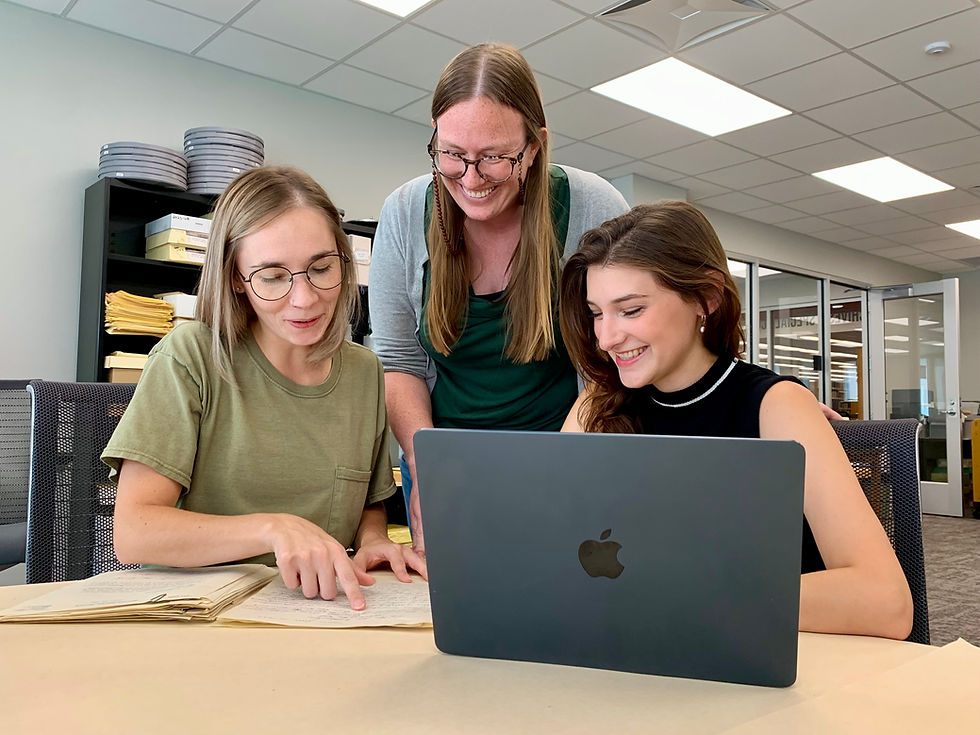
A university archival reading room evokes a familiar atmosphere: a quiet space filled with the soft sound of old papers rustling as a researcher combs through a treasured collection. The faint scent of aging paper and vanillin drifts through the air as documents are gently turned. Nearby, rows of carefully arranged archival boxes sit on carts, each holding the promise of discovery. Nearby, archivists are training interns in archival processing, and an emeritus professor is authoring a blog post about the university’s history. Its alumni-staff are transcribing oral history interviews, while an artist-photographer is teaching a student intern to image historical photographs. Not only does their work support a wide range of research inquiries, but it also provides hands-on training for a new generation of professionals. They also support a network of students, interns, and scholars who are collaborating beyond the reading room to produce resources like the Civil War & Reconstruction Governors of Mississippi (CWRGM). When USD hired me to direct the development of digital scholarly editions, it was in part to increase engagement with and access to high-quality, edited archival materials, and in part to build on the ways the Archives & Special Collections, Digital Imaging Lab, and Oral History Center are preparing students for the professional workforce. Digital scholarly editions offer students from diverse academic backgrounds opportunities to apply their education in ways that build professional skills and workforce readiness through practical, transferable experience. CWRGM provides a few examples. Supported by a Library of Congress Teaching with Primary Sources grant, a local educator and I hosted an institute for social studies education and history students from USD, South Dakota State University, Augustana University, and the University of Sioux Falls. They experimented with an inquiry-based teaching approach that combines teaching the historical research process with digital museum exhibit curation while exploring emancipation in wartime and postwar Mississippi. Thanks to support from a Chiesman Center for Democracy Civic Education Grant, Sam Goldsmith, a doctoral student from the USD School of Education and middle and high school history teacher, is working as a summer researcher to write brief guides and discussion questions that help students interpret a collection of 21 primary sources from the Library of Congress and CWRGM. These sources are featured in Brine & Blood, CWRGM’s educational game designed to help students better understand the process of wartime emancipation through engagement with archival documents. Anushka Pokharel, a USD mathematics and computer science student, used a Monte Carlo simulation to mathematically validate the statistical balance of Brine & Blood. Through the project, she learned to think both mathematically and humanistically, offering game balance adjustments grounded not only in quantitative analysis but also in historical evidence and the lived experiences of people in Civil War-era Mississippi. She presented her research at the Upper Midwest Honors Conference and IdeaFest, where she received an Undergraduate Research Award recognizing her interdisciplinary research and its application to history education. CWRGM undergraduate and graduate student researchers and editors — as well as interns from USD and high schools and universities around the country — have also presented at national conferences such as the Library Publishing Coalition Conference on topics including their research, student learning and training, and scholarly editing. At the Association of Documentary Editing Annual Meeting, Elisabeth Kluin, a USD English graduate student, presented her National Endowment for the Humanities (NEH)-funded research on collaborating with web developers to explore how artificial intelligence might assist with subject tagging large-scale digital library collections and scholarly editions. In part thanks to grant support from the NEH and the National Historical Publications and Records Commission, dozens of high school, undergraduate, and graduate students from a variety of disciplines have worked and interned on the project, producing its metadata, transcriptions, subject tags, and annotations. They are the team that makes the edition possible, learning to read and decipher cursive handwriting, investigating context clues within documents using online newspapers and census records so they can interpret, subject-tag, and annotate the collection. Along the way, they become stronger researchers and communicators. They are introduced to the workflows, best practices, and professional skills used in editing and publishing, libraries and information science, archives and special collections, and digital humanities, and beyond. They sharpen their contextual analysis, pattern recognition, and abductive reasoning skills as they master deciphering handwritten text from hundreds of different authors. Far removed from the reading room, they are the workforce incubator behind the digital collections — training, honing their skills as they research, edit, and interpret the archival materials they are helping make discoverable and accessible to anyone, from anywhere.